PM Scholarship for wards of police personnel martyred in terror/Naxal attacks: Rs 36,000 a year, apply by 30 November
The Prime Minister's Scholarship Scheme (PMSS) for wards of States/UTs police personnel martyred in terror or Naxal attacks is open on the National Scholarship Portal till 30 November 2026. It pays Rs 3,000 a month to girls (Rs 36,000 a year) and Rs 2,500 a month to boys (Rs 30,000 a year) for a first professional degree. The scheme is run by the Ministry of Home Affairs under the National Defence Fund.
Scoped update: 2 November 2026. The live NSP scheme list now shows this scheme with student applications till 30 November 2026, defective application and institute verification till 15 December 2026 and nodal verification till 31 December 2026. Our earlier version said 31 October, 15 November and 30 November. Original publication date unchanged.
Official publisher artwork, cropped by AiCoN to omit the national emblem. Original: https://scholarships.gov.in/. Independent guide, not affiliated or sponsored.
Who can apply
- Dependent wards of States/UTs police personnel martyred during terror or Naxal attacks
- Pursuing a first professional degree: Engineering, Medicine, Dental, Veterinary, BBA, BCA, B.Pharma, B.Sc (Nursing), Agriculture, MBA, MCA and similar courses
- Minimum 60% marks in the minimum entry qualification (10+2, diploma or graduation)
- For renewal: pass each academic year with at least 50% marks
- Marital status does not matter; up to two children per family
What you get
- Girls: Rs 3,000 per month (Rs 36,000 a year); boys: Rs 2,500 per month (Rs 30,000 a year), paid annually after selection
- For up to five years, depending on the course
- 500 fresh scholarships a year for this police category (250 boys, 250 girls), plus renewals
- Selected fresh applicants also receive a personal letter from the Prime Minister
Dates for 2026-27
- Student applications: open since 1 June 2026, close 30 November 2026
- Defective application and institute verification: till 15 December 2026
- DNO/SNO/MNO verification: till 31 December 2026
How to apply on NSP: step by step
Checked on the live National Scholarship Portal on 19 October 2026. NSP now uses One Time Registration (OTR) - do this first if you have never registered.
- Open scholarships.gov.in (Academic Year 2026-27 is live), click Students → Apply now, then Register. Registration is free - no fee is required.
- Read the OTR guidelines, tick the consent boxes and click Next. Register your active mobile number and verify it with the OTP; a reference number is sent to your mobile.
- Complete eKYC: install the NSP OTR app and the Aadhaar Face RD app on an Android phone and do face authentication with the reference number. Your OTR ID is then generated. Aadhaar is required; a minor without Aadhaar can register with a parent's or legal guardian's Aadhaar.
- Log in on NSP with your OTR ID, open Fresh Application for Academic Year 2026-27 and choose the PM Scholarship for wards of police personnel martyred in terror/Naxal attacks from the scheme list.
- Fill the application form and upload the documents it lists.
- Submit before 30 November 2026. Track the application in the same dashboard; institute and district/state verification happen after you submit.
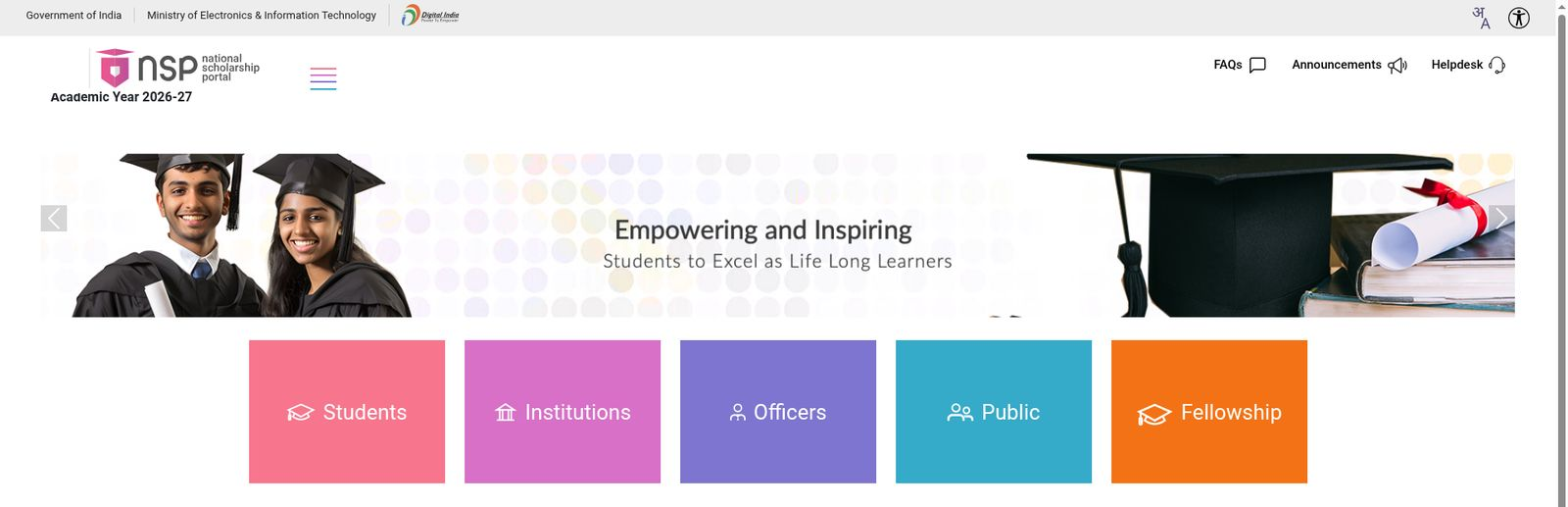
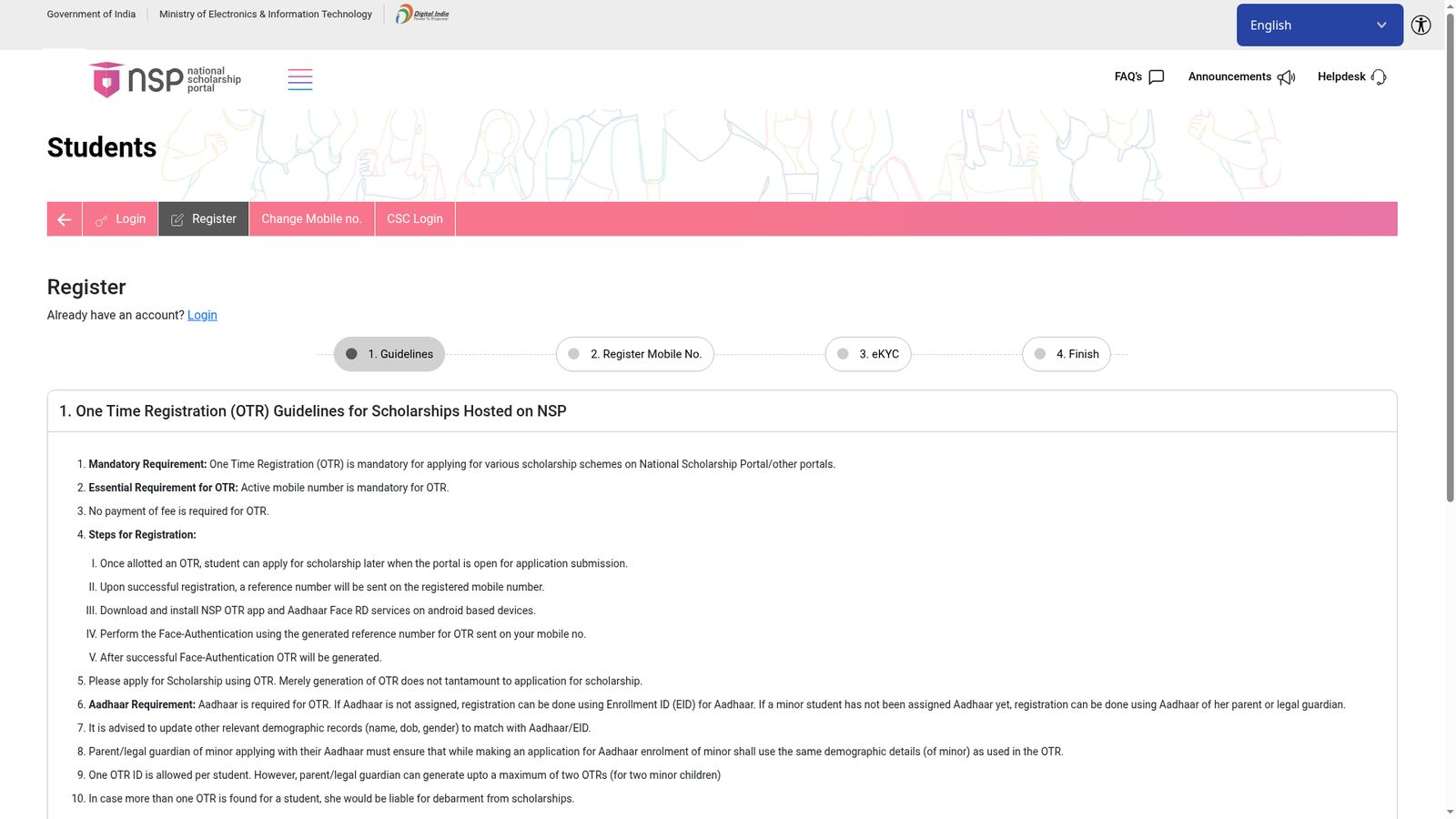
Steps 4-6 happen inside your own NSP login, so they are not shown as screenshots. Generating an OTR alone is not an application - you must still log in and submit the scholarship application.
Video guides
We searched YouTube on 19 October 2026 for a step-by-step application video for this scheme on the current NSP OTR portal in English and in Malayalam. The videos we found cover older portal versions or could not be verified to match the current portal, so we are not linking any rather than risk outdated or unrelated instructions.
We read the NSP scheme listing and the official WARB revised guidelines for 2026-27 (18 pages) on 18 October 2026.
Sources: National Scholarship Portal, PMSS revised guidelines 2026-27 (WARB, MHA). Checked 18 October 2026; application steps and video search re-checked 19 October 2026. This is an AiCoN explainer, not a government publication.