Heidi II: clinical agents, review controls and rollout limits
Heidi II adds clinical and administrative agents around patient visits. It is software for care teams, and access, patient-data handling and approval settings need checking before use.
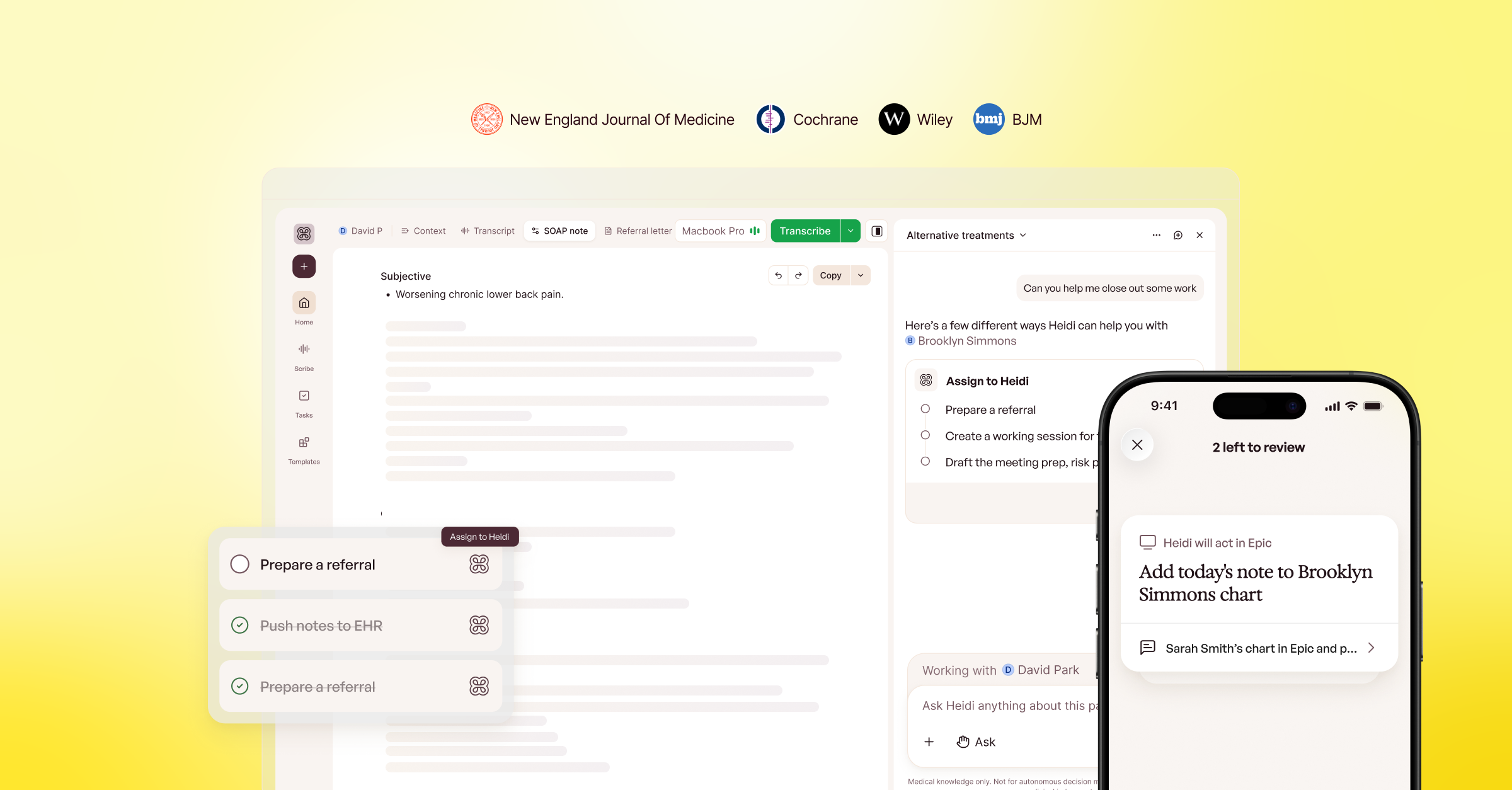
Official publisher artwork hosted by its publisher. Official source. Independent guide, not affiliated or sponsored. Artwork and trademarks belong to their owners.
What is new in Heidi II?
Heidi's launch page describes an agentic layer across a clinician's calendar, inbox and portals. It gives examples such as pre-charting a ward round, finding pathology results, completing referral forms and drafting handover letters. These examples explain the product's intended work; they do not prove it can access every hospital system.
A Home view brings scheduled patients and tasks together. Saved tasks can become Routines that run on a schedule. Memory learns formatting preferences and corrections, while research features bring cited medical material into the workflow. A citation still needs checking for relevance to the actual patient and decision.
Manual mode is the starting point
The official page says Heidi starts in Manual mode. By default, work touching a chart, reaching a patient or leaving the system waits for review, and a user can stop a run. It also says users can switch to Auto mode for tasks they trust.
This means the original "not an autopilot" wording needs care. Human responsibility remains, but it is not accurate to promise that every action always needs an individual approval in every mode. Understand the exact settings and allowed task before changing modes.
The company says Heidi will not prescribe, delete a record or submit a claim in any mode. That is a documented product boundary, not a reason to skip review of the work it can do. An incorrect note, referral or patient message can still cause harm.
Is it available in India?
On 24 October, the US launch page displays 20 October 2026 and says rollout is in English, with more languages to follow. That is the source's current displayed date, not a change to this guide's original publication date. It says Heidi II is coming to Asia and the Middle East and is not available in the EU and UK. Rollout wording differs by region; the US page remains the source for the restrictions stated here.
These statements do not establish that every Indian account has the agent features today. Check your account and ask the provider about your region, language, clinical setting and integrations. Do not treat the availability of ordinary Heidi scribing as proof that the new agents are enabled.
Free plan versus agent usage
Heidi has a Free route, and its official pricing material describes free standard-template transcription and notes. Agent and advanced-feature limits are separate from unlimited basic scribing.
The checked pricing sources are not fully aligned. On 24 October, the US pricing page displays Clinician Standard at US$110 per user per month, billed annually, excluding applicable sales taxes. This is not a verified Indian checkout price, and Max and Teams differ. The public pricing material describes Free weekly trial allowance and paid monthly agent capacity, while the help page describes older plan names and ten shared monthly actions for some Free features. Do not assume a single allowance covers every account or Heidi II rollout. Read the current limit shown in your account and confirm paid terms before relying on it for a clinic's workload.
The guide does not quote an unverified India price. A trial, a free seat and a paid clinical subscription are different offers. Check the billing period, usage allowance, renewal and which features are actually enabled.
How a care team should evaluate it
- Confirm regional availability and the organisation's approval to use the product.
- Review data agreements, access permissions, retention and patient-consent requirements.
- Start with a safe test workflow and Manual mode.
- Check which charts, inboxes and portals it can access.
- Review every draft for patient identity, facts, wording and the intended recipient.
- Test what happens when a task fails or a source is missing.
- Only consider recurring or automatic work after agreeing its limits and review process.
Clinical and privacy limits
Do not upload patient information to an unapproved account or use a personal login as a shortcut around a hospital's process. Memory, connected systems and scheduled work extend beyond a single note, so the team needs a clear account of what is retained and who can access it.
The company's certifications and control claims are useful starting points, not blanket proof of compliance for every country or organisation. The service does not remove a clinician's need to make and check care decisions.
The Product Terms say out-of-session Evidence queries must not include protected health or patient-identifiable information, and must not be treated as patient-specific clinical advice. In-session access depends on regional availability and permitted functionality; source licences may also be needed.
The current privacy policy is more specific than a blanket no-training claim. It says Health Information is not used to train, develop or improve models; organisation agreements govern customer data, and paid-individual content is not used for model training. Free-plan terms can permit de-identified content to develop, train, test and improve models/products, only after that permission validly takes effect and subject to stricter agreements. A trial or preview does not by itself change those permissions. Third-party processors may handle relevant content to provide a feature.
Retention is configurable, not automatically zero. The policy says audio is deleted after transcription unless a recording-saving feature is enabled; session data can remain until deleted or under configured retention. Disconnecting a system is not deletion. A separate assistant chat or copied material can survive source-session deletion, and backups may take longer. Confirm the organisation's settings and agreement before use.
What changed since the original AiCoN post?
This guide adds Manual versus Auto mode, actions excluded in every mode and the region-specific rollout wording. The 24 October scoped recheck updates the source's displayed launch date and adds plan-specific privacy, retention and Evidence-use limits. It also avoids calling all agent work free or universally available, because the current pricing sources and account limits need reconciliation.
Frequently asked questions
Does it prescribe medicine?
The company says prescribing is off limits.
Does Free mean unlimited agents?
No. Basic scribing and agent allowances differ.
Is India access confirmed for everyone?
No. Verify the actual account and rollout.
Sources: Current Heidi II launch page · Review-control explanation · Official pricing · Plan help, differing allowances · Privacy policy · Product Terms. Checked 7 October 2026.
Scoped recheck 24 October 2026: Official launch/control, pricing, plan help, privacy and Product Terms rechecked. Current launch displayed date is 20 October, replacing prior source-date wording without changing original article date. English rollout still says Asia/Middle East coming and excludes EU/UK; India account access unconfirmed. US Clinician Standard $110/user/month annually excluding taxes is not India price. Public weekly/monthly-limit versus help ten/shared/unlimited discrepancies remain explicit. Added out-of-session Evidence exclusion for patient-identifiable information, plan-specific no-training/de-identified-content distinctions and retained chats/copies/backup limits. Official media retained. No patient data, account, integration, clinical action, trial or purchase tested.