Can I use: read the caveat before shipping
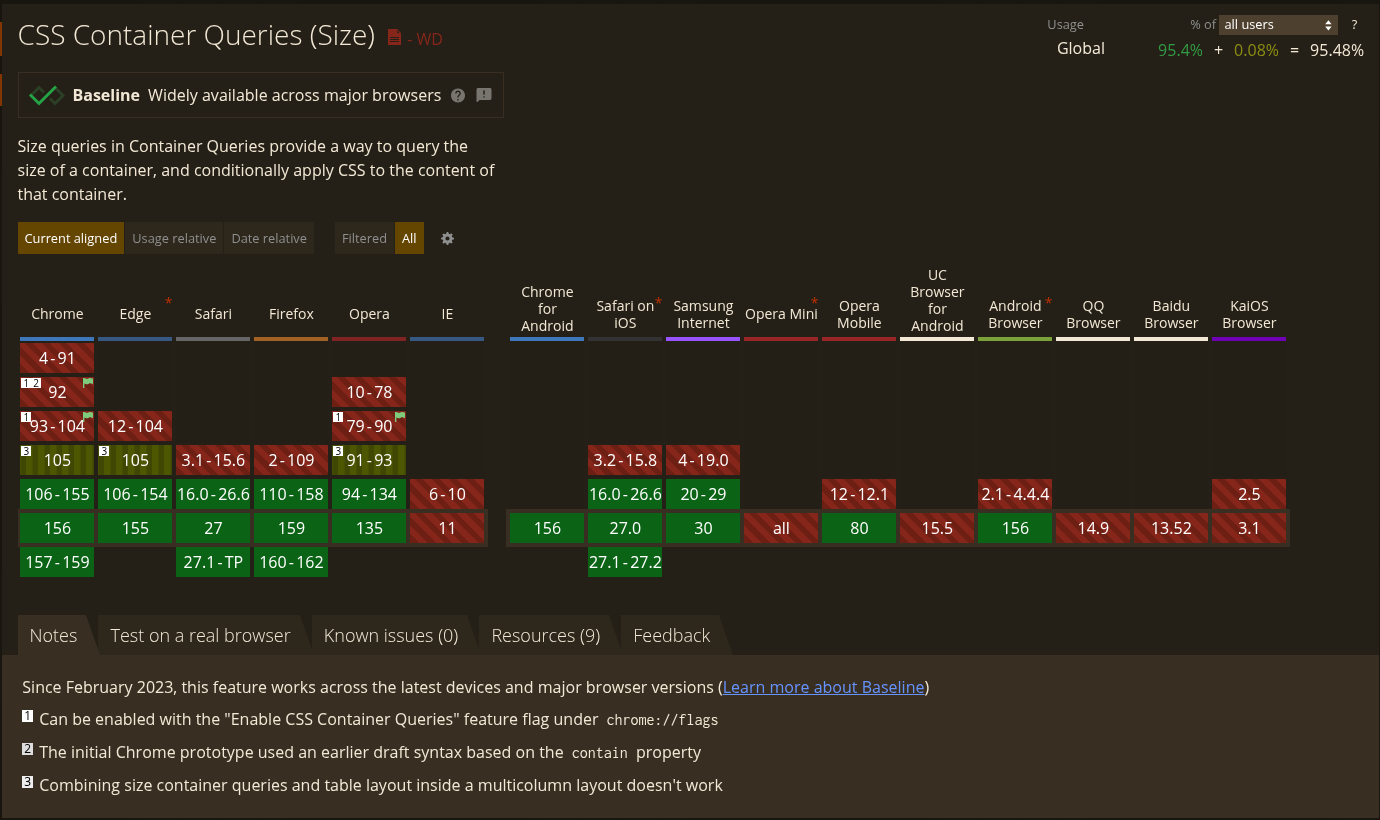
Before you add a web feature, check which browser versions support the exact part you need. Can I use puts version-by-version tables and their caveats in one place. In our live check, CSS container size queries had supported entries where the related style-query table still showed partial support. The note underneath explained why that difference matters.
Quick facts
- Best fit: developers and people reviewing a website's feature choices. Search an exact CSS, HTML, JavaScript or other web-platform feature.
- Actual test: searched "container query", opened the separate size-query and style-query pages, and read their tables and notes on 29 October 2026.
- Important distinction: the style-query table's partial-support note says those entries work only with CSS custom properties in the style() query.
- Access: public search, tables and notes worked without an account, card or payment. The site separately offers Patreon support to disable ads; we did not buy it or test partner services.
- Data: the site's FAQ says support means the primary purpose is largely fulfilled, not 100% support in every case.
- Scope: we tested the lookup workflow. We did not run these CSS features on real phones, Safari, Firefox, older Chrome versions or a production site.
Why check it beside a chatbot?
A chatbot can help choose an approach or explain syntax. Can I use gives you a feature-specific table with version ranges, partial-support markers and linked notes that you can cite in a review. The useful step is not asking whether a browser supports "container queries" in general. It is choosing the correct feature page and reading what each marked version actually supports.
This is a specialist reference, not an AI code generator or an automatic site audit. A support table can help you plan a fallback, but it cannot prove your implementation works.
Our check: similar names, different support
We entered "container query" in the public search field. Results separated CSS Container Queries (Size), CSS Container Style Queries and CSS Container Query Units, alongside related results. We opened the size and style pages separately.
On the size-query page, Chrome 105 was marked partial and the 106-155 range supported. Safari's 16.0-26.6 range and Firefox's 110-158 range were marked supported in the live table. The size-query note also described a limitation when combining size queries and table layout inside a multicolumn layout. These are dated observations of the table, not new tests of those browsers.
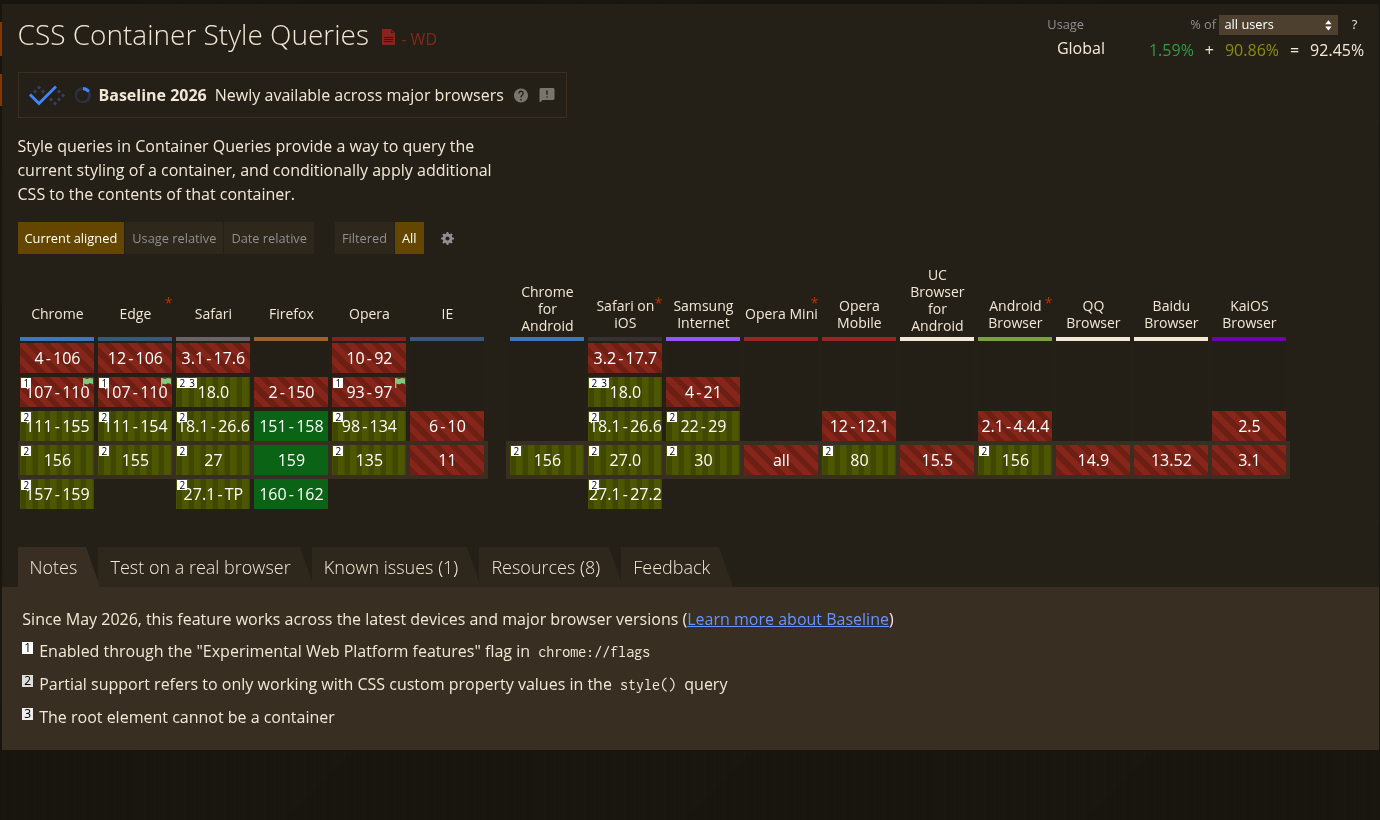
The style-query page marked Chrome's 111-155 range partial, while its size-query table marked the overlapping versions supported. On the style-query page, note 2 limited those partial entries to CSS custom properties in style() queries. Do not translate a partial entry into a promise that arbitrary CSS property queries work.
Both pages also carried Baseline information. A headline availability label is useful context, but it does not erase the feature table's partial-support notes. Read the exact scope before treating two related features as interchangeable.
A five-minute compatibility review
- List the feature you actually intend to use. Include the subfeature, such as container size queries versus style queries, rather than a broad technology family.
- Search caniuse.com. Open the exact matching result and confirm its description matches your code.
- Find the browser and version ranges your audience needs. Distinguish Supported, Partial support, Not supported and Support unknown using the legend and text, not colour alone.
- Read the numbered notes and relevant known issues. A disabled-by-default flag or narrow partial implementation is not ordinary production support.
- Keep the feature link and checked date with your decision. Build a fallback when needed, then test your actual page in the browsers and devices you support.
The default display can hide low-usage older versions. The site's home guidance says older versions are normally shown only at 0.5% usage or above and that Settings can change this threshold. We used the All view shown in our captures; we did not test custom audience imports or regional usage settings.
Usage percentage is not your audience
The live footer attributed browser-usage statistics to StatCounter GlobalStats for September 2026. A global usage figure is not a guarantee about your customers, company-managed devices, or visitors in India. The fetched page and live UI also showed different aggregate percentages during our check, so we have not published one as a fixed number.
Use your own supported-browser policy and permitted audience evidence to decide what matters. We did not connect Google Analytics or any Google account, import private visitor data, or use partner browser-testing links.
Limits to keep in the decision
The official FAQ says its hand-crafted tests check basic feature support and defines supported as the feature's primary purpose being largely fulfilled. That leaves room for bugs and edge cases. A green cell is not a guarantee about performance, accessibility, security, rendering quality or every syntax variant.
Check documentation for implementation details, and test the finished page. For example, MDN explains how container size queries differ from style queries, but prose can contain older time-specific statements. For a compatibility decision, reconcile the current version table, its notes and the exact API or syntax you need rather than treating an old paragraph as a current universal rule.
The public lookup needed no file upload. We did not audit privacy, test site access from an Indian connection, verify every table or try the paid ad-free option. Raw support data is available on GitHub; the official FAQ and repository state CC BY 4.0 for support data, with attribution required.
Sources
- Actual search, size-query table and style-query table
- Official FAQ: testing, support definition and data licence
- Official homepage: legend, older-version threshold and data credits
- Official raw-data repository and attribution
- MDN: size and style query concepts
- Web Features Explorer: container size-query context